The Story Behind the Fabulous Gumbo at Cajun Belle
"If it was four-legged and furry and didn’t have a collar, I put a fork in it,” said Zack Hollier of his life on the bayou. It's his story (and not those bayou critters) that makes his gumbo so good.

Cajun Belle
5460 Merle Hay Rd, Suite A; Johnston
www.cajunbelleia.com
No phone number listed. Note: drive-through only; no dine-in.
I recently got in touch with Zack Hollier, owner of the Cajun Belle drive-through restaurant in Johnston, with just one goal in mind: I had to find out why his gumbo tasted like no gumbo I’d ever had before.
It’s not like I’m unfamiliar with gumbo. I’ve traveled to New Orleans a couple times. I dined at plenty of Cajun restaurants in 80s/90s, when Cajun cooking was having a heyday across the country (including in New York City, my neck of the woods for part of that time — RIP, Great Jones Café). We’ve seen a few good Cajun restaurants in Des Moines. I’ve cooked gumbo myself, for heaven’s sake.
But I swear I’d never really tasted everything a gumbo could be until I picked up some from Cajun Belle. As I ate it, I realized that what I’d mostly tasted in the gumbos past was much about spices and meat and fat—all good things, of course. But this one had a depth of flavor that went beyond meat and spice, and it had a richness that had little to do with fat. This gumbo was something else entirely.
What’s his secret?
“Each pot of gumbo takes at least eight hours, and there’s just a lot of love that you’ve got to put in the gumbo,” says Hollier. “And you can’t shortcut love.”
Indeed. Love is my favorite flavor. Still, I pressed him for more details.
Like all great gumbos, Hollier’s starts with a roux—but his roux is different from all the other gumbo-roux recipes I’d ever seen or cooked.
“There are a lot of ways to row the boat,” he says of making roux. In his case, instead of cooking flour in fat until it takes on that legendary dark-copper-penny color, he goes the dry-roux route. No fat. Instead, he simply toasts his flour.
Well, maybe not so simply. It has to be just right, or he has to start over. “I learned that the roux needed to be the color of the bayou—and because the bayou was just outside my door growing up, I could see what color it needed to be.” The toasted flour adds smokiness, nuttiness, and helps thicken the stew—without the added fat.
He browns his Cajun pork sausage and drains the grease off that, too. He sweats the Cajun trinity (celery, onions, and red and green sweet peppers) and the garlic. He simmers his chicken “until you shake it and it falls off the bone.” Once again, he skims the fat.
In goes the filé, a powder, made from ground dry sassafras leaves, which also adds thickness as well as an added smokey sensation. Lastly, he adds the Creole seasoning (he uses Zatarain’s—it’s not too spicy, so it allows him to control the heat level to his own style—which I found is less about heat and more about flavor).
“Then we cook and taste until I can hear my ancestors say ‘c’est bon.’ And then we go and find a belly to put it in,” says Hollier.
There is, of course, more to the gumbo than just a guy with a great recipe. As Hollier says, “It’s my story that makes my food taste so good.”
“Squirrel, frogs, armadillo, rabbit, turtles, wild hogs . . . we just had to skin it and figure out what seasoning to put on it. If something crawled up the back porch, it might end up in the freezer.”
“I grew up doing everything that goes into a gumbo—from hunting what goes into the gumbo to preparing what goes into the gumbo, then eating what goes into the gumbo.”
Of course, I had to go and ask just what went into those gumbos and other foods of his youth.
“If it was four-legged and furry and didn’t have a collar, I put a fork in it,” said Hollier. “Squirrel, frogs, armadillo, rabbit, turtles, wild hogs . . . we just had to skin it and figure out what seasoning to put on it. If something crawled up the back porch, it might end up in the freezer.”
Actually, it sounds like fur was optional (and just to be clear: no squirrels, frogs, armadillos, rabbits, turtles, or wild hogs were harmed in the making of the gumbo at Cajun Belle.)
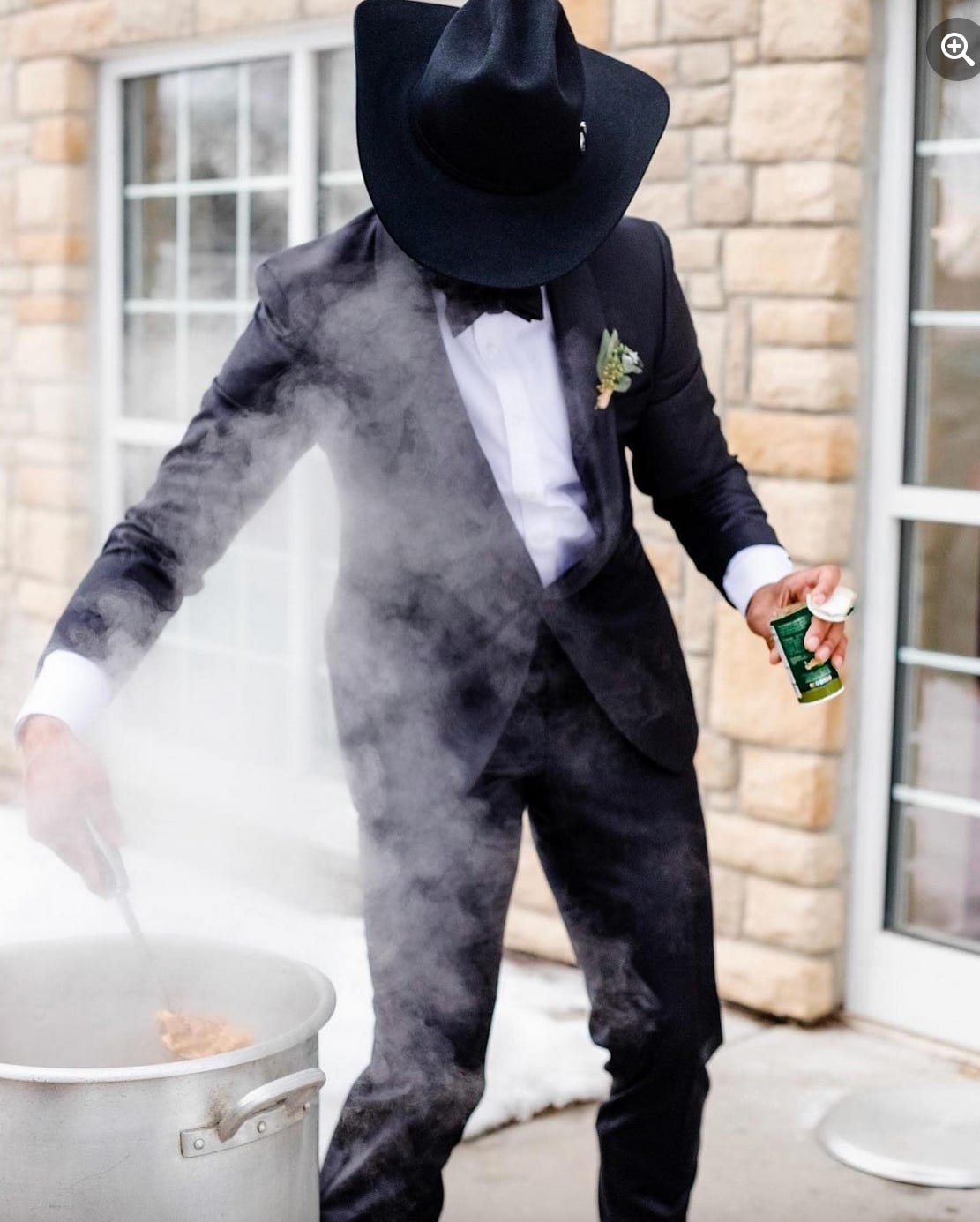
Hollier speaks in an accent that comes from his southeast Texas upbringing. He peppers his speech with all kinds of metaphors, and plenty of “yes ma’am’s” and “yes sir’s,” and a kind of melodic smoothness through and through. “Ma’am” is two syllables, of course. And as you leave, he’ll likely tip his Stetson to you (though some days it’s a Resistol).

He grew up on the Pine Island bayou, about 30 minutes from Louisiana and about 30 minutes from the Gulf of Mexico (as the crow flies). He says that when he was in around seventh grade, his family hit hard times; they spent some years hopping around from relative to relative, often staying with the maternal grandmother and grandfather whose house—built on nine-foot pylons—is depicted on the mural beside Cajun Belle’s drive-through window (above).
“When we had three days of rain, I had to take our bass boat to the bus stop to get to school,” he says.
So, how does a bayou-dwelling, bass-boat-commuting, critter-hunting southeast Texan make his way to Des Moines?
We have Grand View College to thank. He was recruited to play football, and after graduating, he stayed on. (“I like it here,” he explains—and that’s that).
For a while, he worked on bridge-building crews—he loves working with his hands, “playing in the mud,” he says, and later had a desk job in construction. His plan was to save money to possibly go to graduate school, but then he veered into the restaurant business, opening the drive-through storefront in May of 2021. He’s also set up at events from farmers’ markets to RAGBRAI.
I was curious why he went to a drive-through-only model. Surely his food—which also includes po’ boys and kolaches and jambalaya—could merit a kind of cozy spot that’s worth pulling up a chair and sitting a spell.
“I saw a lot of deep waters and strong currents and a lot of boats sinking in it,” he said of the dine-in model. “I know how to do two things. I know how to make good food and how to make people happy.”
In keeping it simple, he’s also trying to appeal to the core of what good food does at the end of a long work day or week. When you work hard, “you want some good food that really just hugs you and makes you feel like your effort was worthwhile,” he says.
“I wasn’t seeing anything that filled my heart and belly—or if I did, I had to go home and get cleaned up—then go into a restaurant. Or go to a place where the food was frozen and fried. That kind of thing just wasn’t doing it for me . . . I just want to make good gumbo and good jambalaya and good food and I hope that’s enough to make people happy.”


The drive-through model definitely worked for the gumbo ($14.99, or $16.99 if you opt for shrimp and crawfish) and jambalaya ($14.99) I enjoyed. They cooled off on the long drive home, but reheated perfectly well. The jambalaya was as terrific as the gumbo—I especially loved the rich, tender pieces of pulled pork shoulder amid the chicken, bacon, and sausage in the boldly flavored rice dish.
Cajun Belle also serves kolaches (sweet or savory pastries made of lightly sweet dough costing $2.00 to $4.25), which are a South Texas specialty. And they serve po’ boys ($10.99 to $13.99). On a lunch stop, I ordered a cherry kolache and saved it for a pleasant tea-time treat—the tender dough isn’t nearly as sweet as, say, a Danish pastry, which I liked.
My appreciation for the po’boys come with a caveat. I feared they wouldn’t travel well, and indeed, by the time I got them home, a 20 minute drive, they simply weren’t all they would have been had I enjoyed them instantly. That said, I could tell that had I tasted them within minutes of grabbing them at the drive-through, I would have loved the perfectly cornmeal-battered and fried catfish (on one) and shrimp (on the other), on nicely toasted French bread, with lettuce, tomato, and a lightly spicy remoulade. So, I’ll be trying the po’ boys again in warmer months, when I can enjoy them in a nearby park. (P.S.: I will say that the kitchen is very generous on the remoulade: I suggest requesting it on the side).
For now—and for upcoming events like the Superbowl and Fat Tuesday and warming winter meals with family and friends—the jambalaya and gumbo will hit their mark however long it takes you to get to and from Johnston. And they’re worth the drive.
The Iowa Writers’ Collaborative
I’ll say it again: The Iowa Writers Collaborative is one of the best ways around to keep track of news and informed opinions in our state! Check out some recent articles, here.


This is a new place for us - definitely going on the “Must Visit” list! I love his reason for the drive-thru model - no one wants to get dressed up to go back out once they get home. That describes us perfectly.
First I’ve heard of this place. Will give it a try. Thanks, Wini!